A Dense Border or a Patchwork of Open Ground?
Compare dense borders with open-ground patches to choose a layout that suits soil conditions and ground-dwelling wildlife, then adjust it with care.
You kneel beside a border to pull a weed and spot a beetle slipping beneath the leaves. A patch of bare soil sits nearby. Choosing between a dense garden border and open ground is less about tidiness than about what the soil and its small inhabitants need from the space.
Continuous planting gives roots room to occupy the soil and keeps its surface under cover. Open patches let rain reach the ground directly and make the surface accessible to creatures that move or forage there. Each layout changes the conditions for plants as well as animals, so the useful question is not which looks more natural. It is which arrangement fits this particular border.
Read the soil before changing the planting
Look at the border from the path, then crouch to inspect the soil between plants. Notice whether fallen leaves gather or blow away, whether the surface is firm or crumbly, and where rainwater collects. A hand trowel can reveal whether the ground just below the surface is easy to work or pressed hard. Avoid digging where you can see roots or signs of animal activity.
Check the same places after ordinary rain and during a dry spell. A gap below a downpipe may stay wet while an opening beside a sunny path dries quickly. The difference matters: replacing ground cover with exposed soil will not solve waterlogging, and adding plants to a dry opening may create competition for moisture rather than a useful shelter.
Notice what grows well, too. A vigorous ground-covering plant may close gaps as it spreads. In other places, seedlings may struggle beneath dense foliage. These are different situations, even if both look like a green or bare patch from the path.
Dense borders keep the soil covered
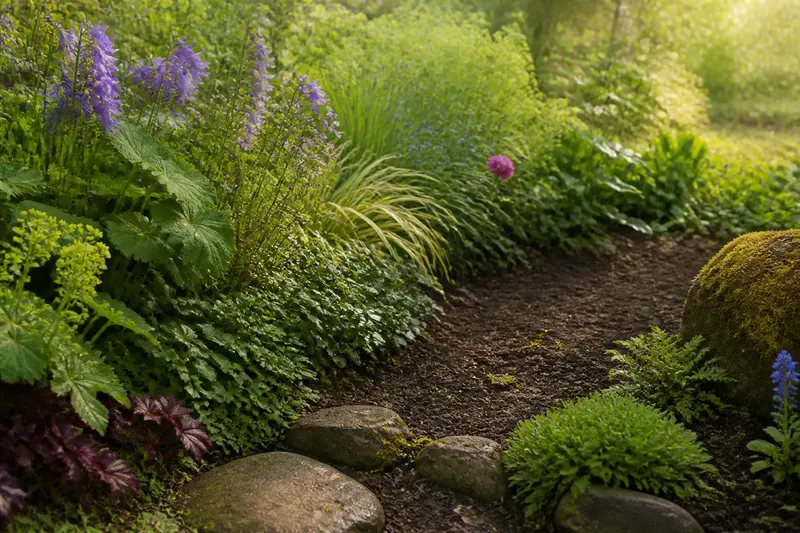
When plants overlap near the ground, their leaves intercept some rain and shade the soil. Roots occupy the same space, and fallen leaves can settle among stems. This arrangement suits a border where the soil surface is exposed to drying or where weeds quickly take hold in open ground.
Density has trade-offs. A crowded planting can make it harder to see where water collects or which plant is spreading. Low-growing neighbours may compete for space, light and moisture. If one species is overwhelming another, thinning the dominant plant at its edge can be more useful than clearing a large area all at once.
For plant relationships, look at how the neighbours share space. A low mat beneath taller perennials may leave the taller plants’ stems clear, while a fast-spreading ground cover may press into crowns and smother smaller plants. The aim is not to make every plant occupy a separate square. It is to prevent one growth habit from taking over the whole border.
Open patches expose different ground conditions
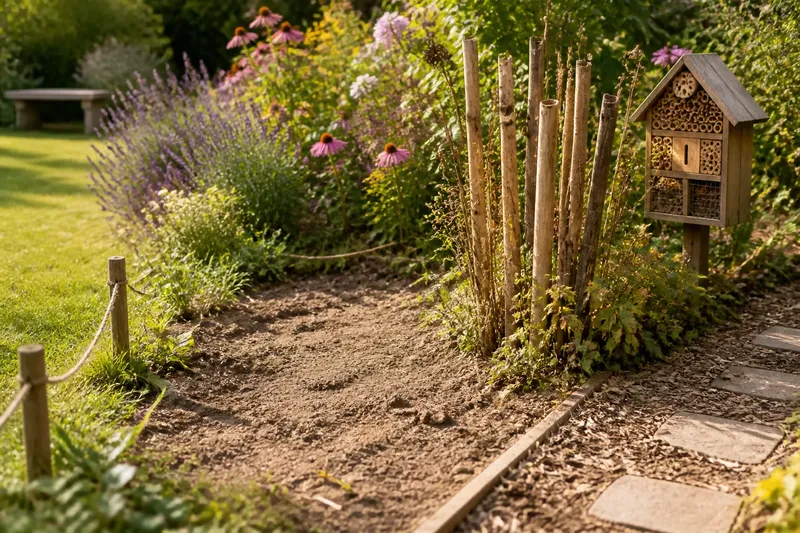
A gap lets light and rain reach the soil more directly. It can also provide room to sow or establish a plant that would struggle among dense neighbours. In a patch of mixed planting, a small opening may help you see whether seedlings are emerging or whether a spreading plant is crossing into space you meant to keep for another species.
Exposed soil can crust after rain, dry out in sun or collect water in a hollow. It may also be colonised quickly by weeds. A clear patch is therefore not a maintenance-free feature; it is a place where the soil’s response is easy to see, for better or worse.
Think of the planting like a bookshelf: packed shelves hold more books, while a clear space lets you reach for one without moving the rest. In a border, the balance is between ground cover and room to work, observe or establish a plant. The best arrangement depends on what is already growing and how the soil behaves.
Make a modest change and check what follows
Choose one small part of the border, not the whole bed. If a plant is spreading into a neighbour, lift or trim only the growth that crosses the boundary, using clean secateurs or a hand fork. If the soil is bare and weeds keep appearing, add a suitable low-growing plant or leave fallen leaves in place where they will not smother young growth. Follow the plant label for its light and soil needs.
Say a narrow border has a creeping ground cover closing around a young perennial. The starting point is a perennial with leaves pressed against the ground cover and no clear space around its crown. Use a hand fork to loosen a small section at the edge, then pull back only enough of the creeping growth to uncover the perennial’s base. Leave the remaining cover in place. The expected result is a visible boundary between the two plants; if the creeping growth returns quickly, the next decision is whether to repeat light trimming or move the perennial to a less crowded spot.
Use these observations to decide what to do next:
- Check whether water remains in a hollow after rain; if the soil stays wet, keep the opening small and address drainage before expanding it, or choose a better-drained spot.
- Check whether the exposed surface forms a hard crust; if it does, add low cover or leaf litter, or move the opening to looser soil.
- Check whether a ground-covering plant is crossing into a neighbour’s space; if it is, trim or lift its advancing edge, or relocate the neighbour if crowding continues.
- Check whether seedlings appear in the opening; if they are wanted, mark them and avoid disturbing the soil, or remove them while small if they are unwanted.
- Check whether leaves pile over the crown of a smaller plant; if they do, clear the crown gently, or thin the plant producing the heavy cover.
- Check whether the path remains accessible without stepping on planted soil; if not, clear a narrow route at the edge, or change how you reach the border.
These decisions are local. An opening that helps one plant establish may be unhelpful a short distance away, especially where the soil, shade or water supply changes.
Keep the layout in step with plant growth
As perennials grow and die back, the balance between cover and open ground changes. A gap in spring may be shaded by summer leaves, while a plant that has been cut back may leave more soil exposed than intended. Revisit the border when its shape changes, rather than keeping every opening bare simply because it began that way.
Make room for routine care without turning the whole bed into a walkway. Use the path or work from the edge where possible. Repeatedly stepping on the same soil can press it down, making it harder to work and less suitable for roots. If access is awkward, a stepping stone placed where it will not cover a plant can give you a stable place to stand.
Where you are unsure whether a plant can be divided, moved or cut back safely, check its label or ask a knowledgeable local gardener. Planting advice depends on the species and the conditions in your garden; a general rule is no substitute for identifying the plant in front of you.
Which border layout fits your garden?
Should I leave bare soil between plants?
Leave an opening where you need room to sow, inspect the soil or prevent one plant from crowding another. If weeds repeatedly take hold or the surface crusts, low cover or leaf litter may be a better fit.
How do I stop ground cover from spreading?
Identify where its stems or runners cross into a neighbour’s space, then trim or lift that edge with secateurs or a hand fork. If the plant keeps returning to the same crowded spot, consider moving the neighbour rather than repeatedly clearing a large area.
Is mulch better than a living ground cover?
Mulch covers soil without adding roots that compete with nearby plants, while living cover grows and may spread. Use the material that fits the plants’ needs, and keep both mulch and leaves clear of plant crowns.
What should I do if water collects in an open patch?
Check whether the spot is naturally low or receives runoff from a roof or path. Avoid enlarging the patch until you understand the source; if drainage remains a concern, seek advice suited to your garden’s soil and layout.
Let the soil set the balance
A dense border and a patchwork of open ground are ways of managing space between plants, not fixed styles to follow throughout a garden. Dense planting can hold the ground under cover; openings make room for access, observation and new growth. Both can work in one bed, provided each patch suits its location.
When choosing between a dense garden border and open ground, start by looking at the soil and the way neighbouring plants grow. Change only the part with a clear problem, then let the next decision follow from what you can see: a spreading edge, a struggling plant, a crusted surface or water that does not drain away.