How to Give Nesting Bees a Place in Your Pollinator Garden
A pollinator garden can feed bees yet leave them without nest sites. Learn how to provide suitable soil, stems and shelter without rebuilding the border.
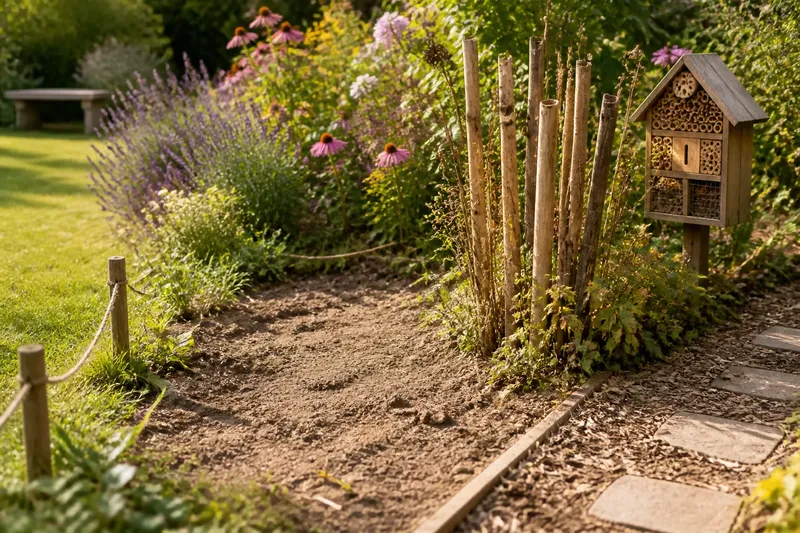
A bee crosses a sunny flower bed, then disappears over the lawn. The blooms are easy to spot; the nesting places used by many solitary bees are less obvious. A pollinator garden needs more than flowers if it is to offer nesting options as well as food.
Different bees use different sites. Some nest in soil, some use hollow or pithy stems, and others occupy existing cavities. The practical task is not to make every corner wild. It is to keep suitable nesting materials available and avoid disturbing them unnecessarily.
Match nesting sites to the bees that use them
Many solitary bees excavate nests in bare or sparsely covered ground. A sunny patch with well-drained soil may suit them, while thick mulch, frequent digging or a permanently wet spot may not. Leave an appropriate patch undisturbed rather than turning it into a general-purpose bare area that gets walked over or replanted.
Other solitary bees use hollow stems, pithy stems or existing holes in wood. Leaving selected stems standing can preserve possible nest sites; a tidy bundle of canes is not an equivalent home for every species. Bumblebees have different nesting habits again, so one artificial structure cannot stand in for all bee habitat.
Keep the distinction clear: a patch of open soil is a specific nesting option, not simply a general wildlife corner. Likewise, stems left for cavity-using bees should be chosen and retained for that purpose, not treated as a substitute for ground nests.
Keep artificial bee hotels in a supporting role
A bee hotel can provide nesting cavities for some solitary bees, provided its materials and upkeep are suitable. It does not serve ground-nesting bees, and it is not a universal pollinator shelter. Before installing one, consider whether there is a suitable place for it and whether you can keep it dry and in sound condition.
Natural options are often simpler to maintain: retain appropriate stems, leave a small soil patch undisturbed, and avoid clearing every possible nest site at once. A hotel is an addition to those provisions, not a replacement for them.
Check each nesting patch before deciding what to do
- Check whether the proposed soil patch is sunny and drains after rain. If it stays wet, choose a better-drained spot; otherwise, leave the suitable patch undisturbed.
- Check whether mulch or regular cultivation covers the soil. If it does, remove that treatment only from the chosen patch and stop digging there; otherwise, keep disturbance away.
- Check whether the patch sits on a route used for walking or routine garden work. If it does, move the nesting area out of the traffic line; otherwise, mark its boundary so it is not accidentally disturbed.
- Check for sound hollow or pithy stems among the plants. If suitable stems are present, retain a selected group through the season; if not, leave appropriate stems standing when cutting back rather than adding unrelated material.
- Check whether a bee hotel is dry and intact. If it is damaged or exposed to persistent damp, repair or remove it; otherwise, leave it in place and avoid treating it as the garden’s only nest site.
- Check whether routine clearing reaches the chosen nesting spots. If it does, change the clearing boundary or timing; otherwise, continue maintaining paths and seating areas as usual.
What do gardeners ask about bee nesting sites?
Do solitary bees nest in bare soil?
Some solitary bees excavate nests in open or sparsely covered ground, often where the soil is well drained. Other bees use stems or cavities, so an exposed patch is one option rather than a complete nesting plan.
Should stems be cut back in autumn?
Leaving selected sound stems standing can retain possible nest sites for insects that use them. Keep paths clear, and avoid removing every stem at the same time if you want to preserve those options.
Can a bee hotel replace a soil nesting patch?
No: a bee hotel offers cavities, while ground-nesting bees need suitable soil. Treat the two as distinct provisions, and choose each only where its conditions can be maintained.
A small worked example keeps the choices specific
Imagine Jo has a hypothetical sunny border with a strip of bare, well-drained soil beside it, a frequently walked path and several hollow garden stems due for autumn cutting. Jo first marks the soil strip as a no-dig area and checks that the path does not cross it. Because the soil is suitable and outside the walking line, Jo leaves it uncovered and undisturbed. Jo then keeps a selected group of sound hollow stems standing rather than cutting them all down. The observable result is two distinct potential nesting options—open soil and retained stems—while the path remains clear; neither change depends on attracting a particular bee.
If the soil strip later becomes waterlogged or is covered during routine mulching, Jo can reconsider its position or management. The point is to respond to the conditions on that patch, not to keep an unsuitable feature for appearance’s sake.
Keep the flower bed and protect the nesting places
A pollinator garden can remain a designed flower bed while providing specific nesting sites nearby. Choose a suitable soil patch, retain selected stems where appropriate, and keep routine disturbance away from those places. A bee hotel may add cavities, but it cannot replace the other options.
When reviewing a pollinator garden, look beyond the flowers and ask which nesting materials are actually present. Then check whether each is in the right condition and whether ordinary maintenance will remove it. That small distinction—between offering a feature and preserving its usefulness—is what turns a decorative provision into a plausible nesting opportunity.